

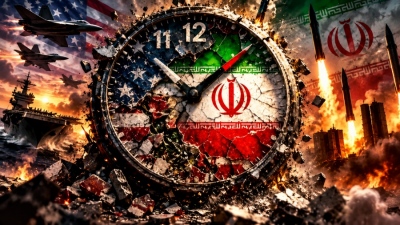
The countdown for a new generalized war conflict in the Persian Gulf has begun. The US and Israel are reportedly preparing a sweeping military attack against targets in Iran, and the only thing left to be revealed is when it will take place. The Pentagon signals that everything is ready: targets have been chosen—among them military, energy, and nuclear installations—and American forces are ready to unleash. Hell within 96 hours should President Trump give the relevant order.
Analysts point out that Trump is moving toward a new attack, although it is noted that the scenario of him taking a step back should not be ruled out. Already, the US president reportedly deterred Israeli Prime Minister Benjamin Netanyahu from an immediate military operation that would lead to the postponement of tomorrow's elections in Israel. At the same time, Iran warns that it is ready for anything and, most importantly, that its retaliation will be sweeping.
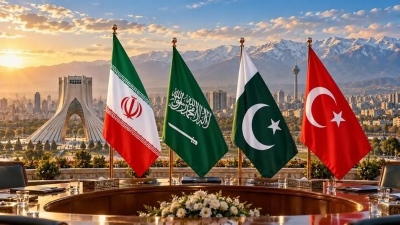
The Houthis are on a war footing, Americans are withdrawing their diplomatic personnel for the Middle East, and the Strait of Hormuz remains one of the most dangerous places on the planet. Amidst this chaotic backdrop, which also features the order to Mossad to pursue the overthrow of the regime in Iran to the end, high-ranking officials from Pakistan, Turkey, and Saudi Arabia are convening today, October 26, in Tehran in a likely last-ditch effort to avert the scenario of an uncontrollable conflict in the Middle East.
The next attack will be sweeping
US forces in the Middle East are ready to launch new, potentially large-scale military operations against Iran "within 96 hours of receiving" a relevant order from President Donald Trump, according to two US officials. According to the same sources, sufficient military forces have now been deployed in the region to carry out potential strikes. The scope of the new US military operations is expected to exceed the logic of limited strikes merely aimed at "mowing the grass" or maintaining the existing regime by striking radars, launchers, and other Iranian military assets that can be quickly replaced or repaired. This was the practice followed since Trump halted full-scale combat operations earlier this year, the sources added. "It will be a large-scale operation," one of the officials told CNN. This assessment is shared by other current and former US officials familiar with internal discussions on military planning. Some of them believe the question is not if, but when Trump will give the green light. They believe the order could be given at any time before the end of the year, although it is most likely to happen after the US midterms.
Fox News: Pentagon directive to US bases for autonomous operation for... 90 days
The Pentagon is preparing US military bases so they can operate autonomously for at least 90 days in the event of a large-scale war that could cause power outages, supply chain disruptions, and the destruction of critical US infrastructure. This is reported by the television network Fox News, citing US Department of Defense documents. As part of the FORTRESS program, military bases must be equipped with independent power sources, as well as reserves of fuel, water, ammunition, and other essential supplies. The plan also provides for the capability to convert civilian industrial facilities into military production units. Pentagon spokesman Sean Parnell stated: "The next conflict will likely be fought on multiple fronts. When that happens, global supply chains will collapse". However, it is clarified that the Fox News report refers to the preparation of the United States for the possibility of a major war in general and not to plans for continuous combat operations against Iran for 90 days.
Extensive target catalog
Iranian forces are now more familiar with American tactics and, therefore, it will be harder for the US military to effectively destroy all potential targets. However, the leadership of US Central Command (CENTCOM) and the Pentagon has drawn up an extensive target catalog, which includes Iran's energy infrastructure, military facilities, and nuclear installations. Officials report that Trump has not yet decided what to do after the midterms, but seems to lean toward ordering large-scale military action. They warn, however, that in the past Trump had appeared ready to proceed with specific actions, only to back down at the last minute. The White House declined to comment, CNN reports. A senior Pentagon official stated: "The department is an organization whose mission is planning and its duty is to develop and execute the military options ordered by the president".
Iran's retaliation will be harsh
Recent US intelligence assessments indicate that Iran and Houthi rebels are treating the possibility of renewed attacks by the US and potentially Israel with extreme seriousness, according to two additional sources familiar with the matter. If the US and Israel launch new military operations against Iran, Tehran and the Houthis will likely respond immediately, targeting American personnel and facilities throughout the region—and potentially beyond it—according to sources familiar with recent US intelligence assessments.
Americans in danger
An unclassified October 23 memo sent by Director of National Intelligence Jay Clayton to Secretary of State Marco Rubio states that US intelligence agencies have found that "Iran has significantly intensified its efforts to target American personnel" and that planned operations "have reached an advanced stage both in the Middle East and in certain other countries". American intelligence officials assess that, at this stage, Iran and the Houthis are unlikely to launch preemptive strikes leading to escalation against American personnel or Israel. However, they will not hesitate to respond if Iran is attacked first by US or Israeli forces, one of the sources familiar with the latest US intelligence assessments pointed out.
Withdrawing diplomatic personnel
However, the regional threat posed by Iran and the Houthis is one of the reasons the US is expected to continue, without much publicity, the withdrawal of personnel from its embassies across the Middle East in the coming days, the source stated. Although the US embassy in Riyadh, Saudi Arabia, is the only American diplomatic mission in the region for which a personnel departure order has been issued, one of the sources told CNN that similar directives are expected to be given to other missions. Those not receiving such orders will be forced to reduce their staff based on a maximum allowable employee cap. Furthermore, according to a US official, non-essential US military personnel scheduled to deploy to the Middle East as part of the next troop rotation were informed they will ultimately not travel to the region. This development underscores the possibility of an impending regional escalation.
The 11 fronts — Where Iran will strike
Within the framework of an Iranian retaliation scenario, the list of potential targets for Operation "Hour Zero" includes critical infrastructure in Israel, Saudi Arabia, the United Arab Emirates, Qatar, Kuwait, Bahrain, Oman, and Jordan. Iranian reports state that this specific list includes bridges, railway networks, airports, ports, underwater cables in the Persian Gulf, petrochemical facilities, power plants, water desalination units, technology and artificial intelligence companies, hotels, and shopping malls. 

Based on this scenario, in the event of an attack against Iran's infrastructure, widespread disruptions to transport, energy, water supply, communications, and trade across the entire region are considered likely. These specific potential targets are presented as additions to initial targets, which include American military bases in the wider region.

Cooper flight over Hormuz
Admiral Brad Cooper, commander of CENTCOM, visited the Strait of Hormuz on Sunday while the US military maintains a blockade of Iranian ports and assists navigation through this critical waterway. Cooper "inspected prevailing operational conditions" by conducting a helicopter flight over the Strait, according to CENTCOM, which added that he met with military personnel who participated in clearing the waterway of Iranian mines. "We continue to stand by our Gulf partners and the shipping industry," Cooper stated in a press release. "This visit underscores our strong commitment to the ongoing safeguarding of freedom of navigation through the Strait of Hormuz," the American general argued. Despite an increase in the number of tankers transiting the Strait, oil prices remain high, partly due to the threat of potential Iranian attacks. A US official acknowledged that the existing situation around the Strait is "unsustainable" in the long term.
Netanyahu was pushing
Israeli Prime Minister Benjamin Netanyahu is pushing for new attacks against Iran. However, US officials have asked him to delay them until the Trump administration is ready to execute joint military operations, according to two US officials and an Israeli security source. "Netanyahu desperately wanted and tried to convince Trump to conduct a joint attack on Iran before the elections, but Trump did not give the green light," the Israeli source told CNN.
Why Trump backed down
One of the reasons Trump refused was that the Chief of General Staff of the Israel Defense Forces, Eyal Zamir, had pointed out to US General Dan Caine, Chairman of the US Joint Chiefs of Staff, that such an action would negatively affect elections in Israel and lead to their postponement, the Israeli source added. Israel had been preparing for about the past week for the possibility of launching additional attacks against Iran and was pressing US officials to support and supplement these new strikes, according to a third source briefed on the matter who spoke to CNN.
Joint attacks
However, senior US officials—including Trump—asked Israel not to proceed for now, hinting instead that the two countries will soon launch joint operations. Israel appears to have postponed, for now, its plans for additional strikes against Iran, but is preparing for potential joint operations with the US, likely after the US midterms, according to all sources. Israel appears to have agreed to postpone new strikes against Iran partly because it needs American support in air defense, the source briefed on the matter added.
The directive to Mossad
Iran and the Houthis will likely respond to an attack with retaliation, while Israel's defensive ammunition stocks have already faced significant pressure during the war. Recent US intelligence assessments indicate that Netanyahu and his allies still lack a clear strategic objective beyond demonstrating some form of "progress" and the continued weakening of the Iranian regime, added one of the sources familiar with the relevant reports. Netanyahu stated this week in a speech during an IDF graduation ceremony that his directive to the IDF, Mossad, and other security agencies is the overthrow of the regime in Iran. "Plans are ready and awaiting Trump's approval. This could happen after the midterms," the same source told CNN.
Baghaei (Iran MFA spokesman): We are ready for everything...
Iranian Ministry of Foreign Affairs spokesman Esmaeil Baghaei stated that Tehran remains prepared for "any eventuality," while keeping the prospect of a diplomatic settlement open. "We have never walked away from the negotiating table nor closed the door on diplomacy," Baghaei told German public television network ARD. "At the same time, we are fully prepared to defend our territory. Therefore, yes, messages are being transmitted via intermediaries," Baghaei added, stressing that Washington insists on unilateral demands, including the demand for Iran's "complete surrender". "This is something no Iranian will accept," he emphasized. Concurrently, the Iranian Foreign Ministry spokesman criticized European countries, accusing them of aligning with the US instead of playing an "independent role" in the conflict. Referring to the situation in the Strait of Hormuz, Baghaei argued that the waterway is unsafe "because the US and Israel are using the entire region to launch military aggression" against Iran. "As long as this situation continues, we have no other choice but to take necessary measures to protect our territorial integrity, national security, and our people," he concluded.
Critical Iran meetings with Turkey, Pakistan, and Saudi Arabia
Ali Bagheri, deputy secretary of Iran's Supreme National Security Council, stated that top defense officials from the Mecca Defence Alliance are expected to visit Tehran today, Monday, October 26, for talks on regional security. Speaking to Iranian state television network IRIB, Bagheri stated that talks with the secretary of Iran's Supreme National Security Council, Mohsen Rezaei, will be attended by Saudi Arabia's Defense Minister Khalid bin Salman Al Saud, Pakistani military chief Field Marshal Asim Munir, and Turkish intelligence chief Ibrahim Kalin. "The defensive model of the Islamic Republic of Iran, which is based on domestic and internal capabilities, has emerged as a successful model for building national security," Bagheri told the TV network. "Iran's strategic policy is to ensure regional security through the countries of the region themselves and to counter any foreign intervention and influence led by the American and Israeli regimes," Bagheri added. This marks the first high-level contact between Iran and all members of the trilateral coalition since the escalation of attacks suffered by Saudi Arabia from Yemen's Houthis, who are supported by Tehran.
Qatar: Talks in Tehran are "usual diplomatic process"
Mediators from Qatar are also in Tehran, as part of a US-coordinated effort to de-escalate rising tensions in the region. Sheikha Alanoud Hamad Saud Al Thani, a researcher at the Middle East Council on Global Affairs, stated that the visit constitutes "a usual diplomatic exchange" and does not necessarily constitute a reaction to recent tensions. "Certainly, there will be intense pressures and a very large effort for de-escalation," she told Al Jazeera. "However, at the end of the day, Qatar is a mediator. It cannot impose its own will. De-escalation must ultimately be the joint will of both Americans and Iranians," Al Thani underlined, warning that Israel could undertake unilateral military action. "The concern prevailing right now in the region is that the Israelis may take the initiative themselves to trigger a new round of conflicts in order to influence upcoming elections," she noted. Sheikha Alanoud stated she does not believe Washington desires a return to hostilities, warning however of the risk of a new military flare-up due to mutual suspicion. "If each side believes the other is going to pull the trigger first, that belief alone can constitute the catalyst for the resumption of the conflict," the analyst concluded.
Message to US: No entry of warships into the Persian
Iranian Major General Ali Abdollahi, in a message regarding the capabilities of the armed forces of the Islamic Republic of Iran, stated that the US Navy, despite the importance Washington assigns to it within its military strength framework, has faced severe limitations due to the actions of the Iranian armed forces. Concurrently, he stressed that Tehran will not allow American warships to enter the Persian Gulf. One of the most significant points of Ali Abdollahi's message concerns contradictions in Donald Trump's statements regarding the nuclear program of the Islamic Republic of Iran. The US president has claimed on different occasions that extensive destruction has been caused to Iran's nuclear facilities, while simultaneously continuing to emphasize the need to prevent Tehran from acquiring nuclear weapons. Abdollahi raised the question: if, according to Washington's claims, all targeted facilities have been destroyed, what is the point of repeating threats against Iran? He characterized these statements as contradictory and assessed they aim to influence public opinion.
The continuation of such claims can be examined from two angles. First, the US government, by claiming it has struck Iranian capabilities, seeks to showcase its military achievements. Second, continued emphasis on preventing Iran from acquiring nuclear weapons shows that the nuclear issue remains an integral part of American security policy toward Tehran. Of course, estimating the degree of destruction of nuclear facilities and determining their current status requires technical data and independent assessments. The simple repetition of political claims cannot substitute for such investigations. However, the question posed by the chief of staff of the Iranian armed forces directs attention to the gap between official claims about the results of military operations and continued political threats.
www.bankingnews.gr







Σχόλια αναγνωστών